The AI Shockwave: What It Means for Junior Engineers
Executive Summary
- AWS (+64%), Uber (+58%), Amazon (+43%) drove explosive junior engineer hiring while traditional sectors declined
- Frontend (-13%), Backend (-12%), Full-stack (-8%) developer roles shrinking as AI automates basic coding tasks
- AI Engineers (+25%), ML Engineers (+17%), SREs (+20%) represent the growing infrastructure-focused junior market
- Senior engineers showed -1% growth overall but Staff Engineers (+8%) and Cloud Engineers (+6%) expanded
- The traditional coding career ladder is fragmenting, with 97 companies analyzed showing polarized hiring patterns
Key Takeaways
- Market polarization: Big Tech hiring aggressively while others cut
- Role automation: Basic web development positions disappearing fastest
- Infrastructure demand: AI/ML and system reliability roles growing
- Career ladder disruption: Traditional entry paths narrowing significantly
- Education gap: Bootcamps training for declining role categories
- Pipeline risk: Fewer pathways into high-paying tech careers
Methodology
Data Sources: GrauntX platform analysis of public professional profiles and employment data across U.S. technology companies.
Time Window: 12-month comparison period analyzing headcount changes from September 2023 to September 2024.
Sample Sizes: 125,000 junior engineers (0-2 years experience) across 97 companies; 510,000 senior engineers (5+ years) across 99 companies, minimum 50 employees per company.
Introduction
When AI reshapes industries, it rarely does so evenly. Some roles expand, others vanish. To see the earliest signals, look at entry-level engineers. Stanford's Digital Economy Lab recently described junior engineers as the "canaries in the coal mine." Our data backs that up.
At GrauntX.ai, we analyzed U.S. engineering headcount across 97 companies for juniors (0–2 years experience) and 99 companies for seniors (5+ years). We also broke the data down by job title. The results show a sharp divergence: early-career engineers are facing volatility and role replacement, while seniors remain more stable — but not untouched.
Junior Engineer Hiring Trends: Workforce Analytics Reveal Extremes
Across 125,000 junior engineers, average growth was +9%. But this average hides dramatic differences:
Explosive hiring in Big Tech. AWS (+64%), Uber (+58%), Amazon (+43%), and Meta (+39%) all hired aggressively. Without them, junior hiring would be flat or negative.
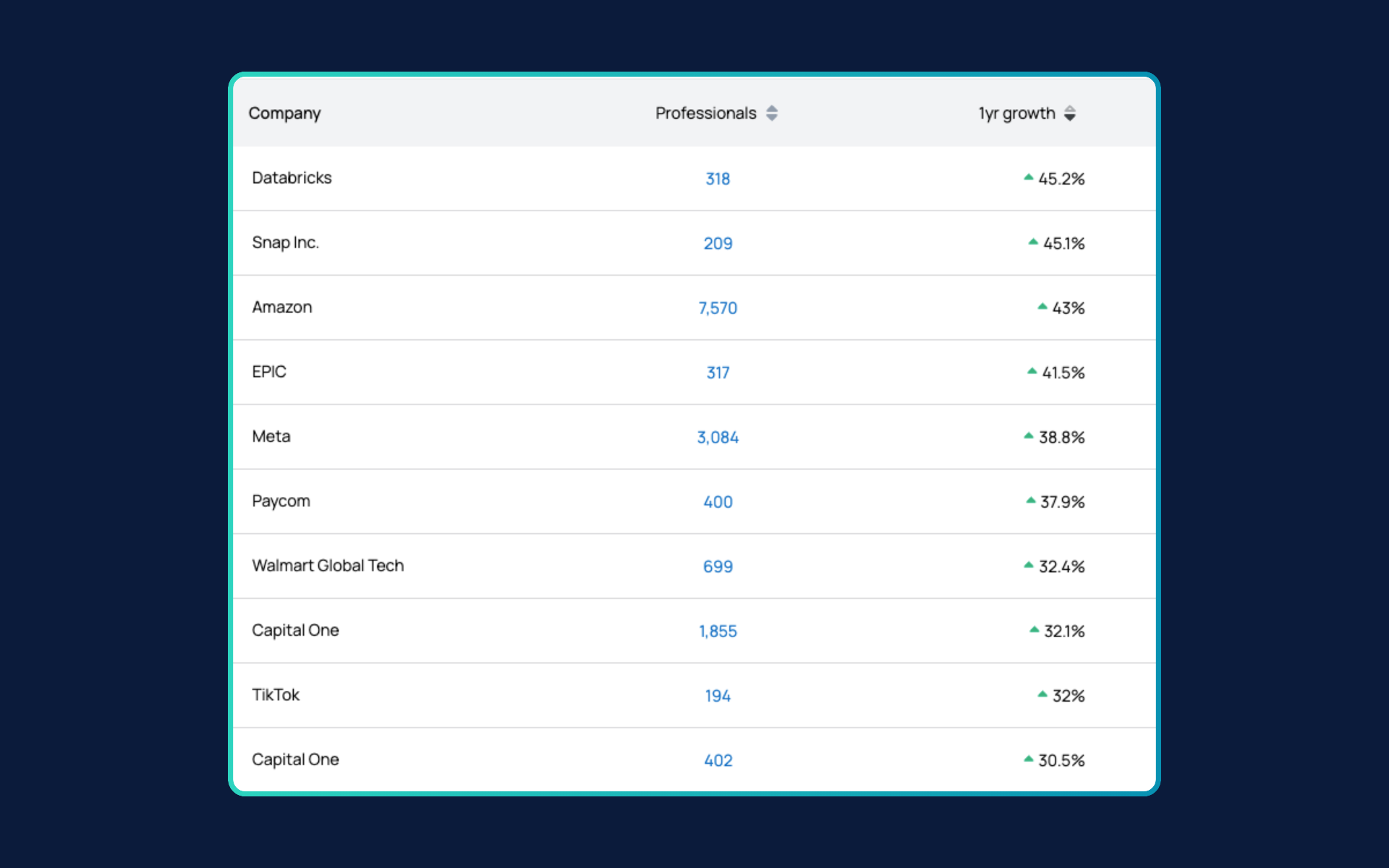
Declines in traditional sectors. Kroger (–3.9%), Walmart (–3.6%), GM (–3.6%), and Boeing (–1.8%) all cut junior engineers. Even Accenture (–1.8%) trimmed.
Polarization. The junior job market is consolidating into a handful of hyperscale employers.
By title, the story is even sharper:
- Growing: Software Interns (+62%), Software Engineer Interns (+35%), AI Engineers (+25%), Machine Learning Engineers (+17%), Site Reliability Engineers (+20%).
- Shrinking: Frontend Developers (–13%), Backend Developers (–12%), Full-stack Developers (–8%), Python Developers (–5%).
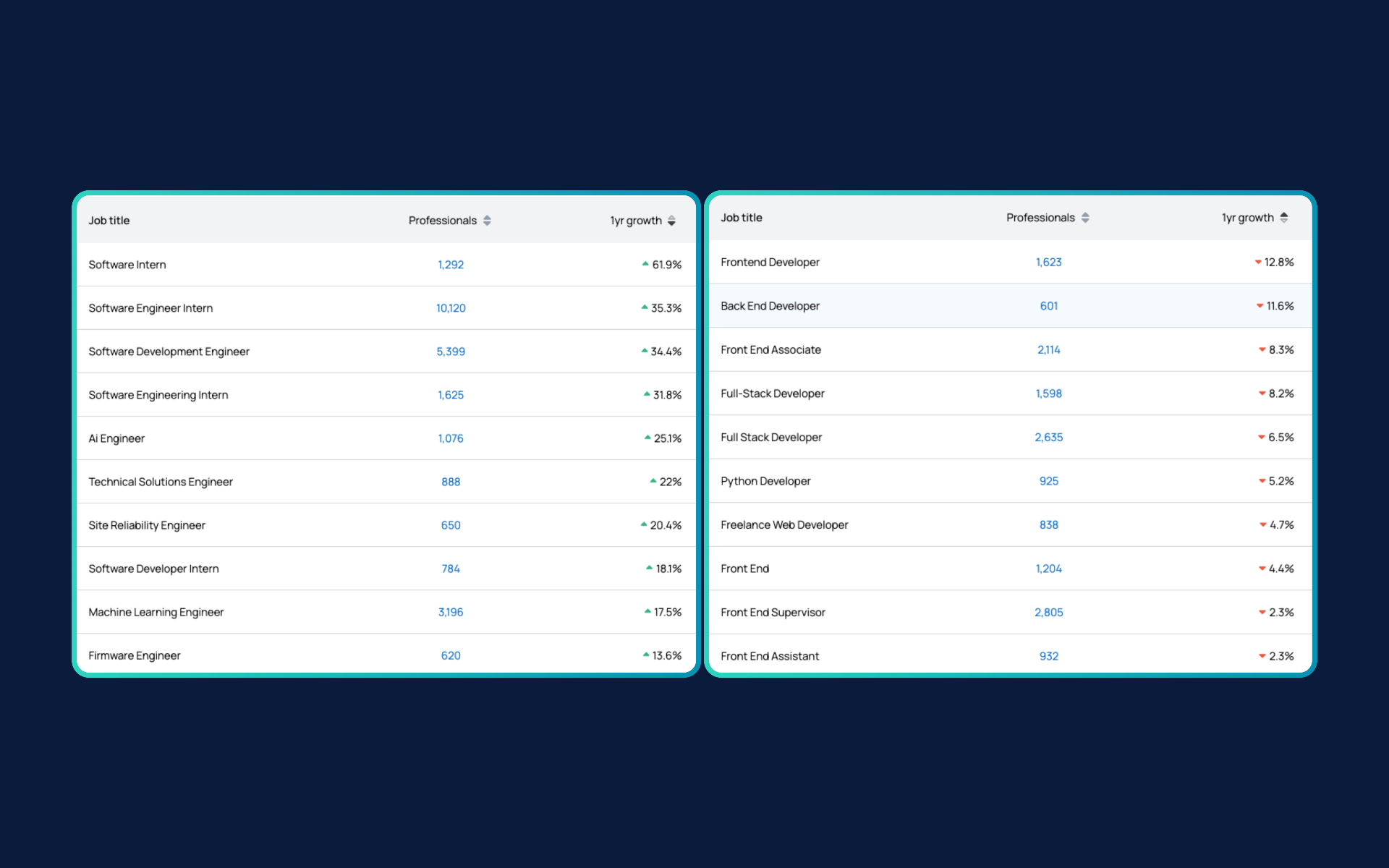
This reflects AI's displacement of basic coding roles — bug fixes, CRUD apps, and simple front/back-end work — while boosting demand for AI/infra-savvy juniors.
Senior Engineer Market Intelligence: Stability with Strategic Shifts
Across 510,000 senior engineers, average growth was –1% — essentially flat. But title-level trends show important shifts:
- Growing: Senior Staff Software Engineer (+8%), Senior Cloud Engineer (+6%), Enterprise Architect (+4%).
- Shrinking: Senior Full Stack Developer (–17%), Frontend Developer (–13%), DevOps Engineer (–8%), Software Engineering Manager (–7%).
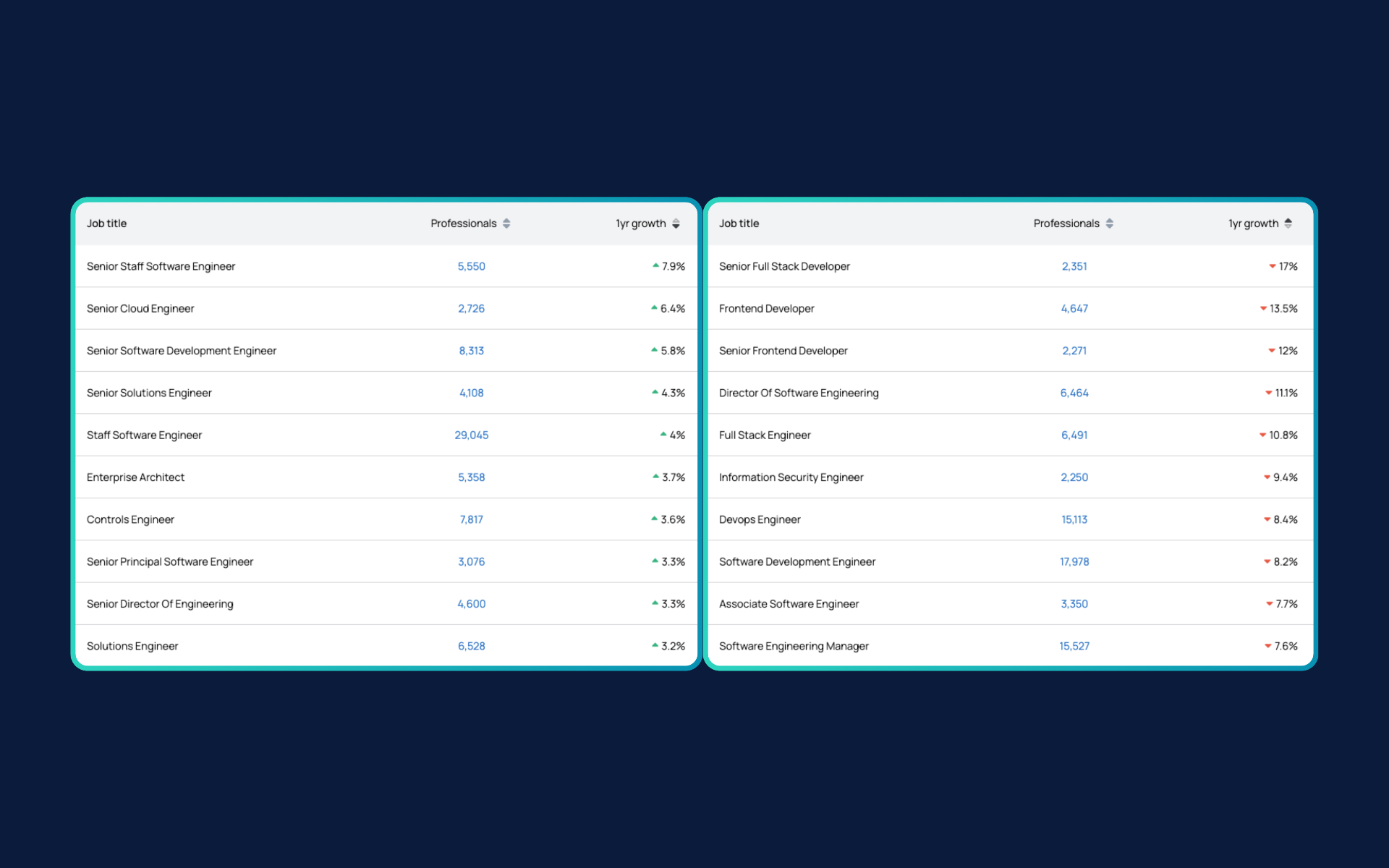
This suggests companies are trimming management-heavy or commodity dev roles, while holding onto senior talent in system design, cloud, and architecture.
What this means for the career ladder
The by-title analysis highlights three big shifts:
- The decline of "classic web dev." Roles like frontend, backend, and full stack are shrinking across both juniors and seniors. AI tools now handle a large portion of this work.
- The rise of AI & infra roles. Demand is growing for AI engineers, ML engineers, SREs, and cloud engineers. These roles require deeper system knowledge and are harder to automate.
- A broken pipeline risk. Juniors are still being hired, but only in niches (AI/infra) or by Big Tech. The broad entry-level coding job that used to launch careers is eroding.